

You encounter Nonwoven Fibers in many daily products due to their unique structure. Unlike woven or knitted textiles, these materials form by bonding fibers together, not by weaving or knitting.
The global market for nonwoven fibers shows rapid growth, as shown below:
| Year | Market Size (USD million) | CAGR (%) |
|---|---|---|
| 2024 | 58,189.0 | N/A |
| 2025 | 62,001.1 | N/A |
| 2033 | 104,508.4 | 6.7 |
Key Takeaways
- Nonwoven fibers are made by bonding fibers together, not by weaving or knitting, allowing for faster production and lower costs.
- These fibers are versatile and used in many products, including medical supplies, hygiene items, and automotive applications, due to their unique properties.
- Understanding the manufacturing methods, such as wetlaid and spunbond, helps you choose the right nonwoven fabric for specific needs.
What Are Nonwoven Fibers?
Definition and Key Features
You can think of Nonwoven Fibers as materials made by bonding fibers together into flat sheets or webs. These materials do not use traditional weaving or knitting. Instead, you see fibers arranged in random or specific directions, then bonded by friction, heat, or chemicals. This process creates a fabric that looks and feels different from woven or knitted textiles.
Industry groups and standards organizations provide clear definitions for nonwovens. You can compare them in the table below:
| Source | Definition |
|---|---|
| EDANA | A nonwoven is defined as ‘a manufactured sheet, web or batt of directionally or randomly orientated fibers, bonded by friction, and/or cohesion and/or adhesion’, excluding materials like paper and woven fabrics. |
| INDA | Nonwoven fabrics are described as ‘sheet or web structures bonded together by entangling fibers or filaments, by various mechanical, thermal and/or chemical processes, made directly from separated fibers or from molten polymers.’ |
| ISO | The ISO definition describes nonwovens as structures of textile materials formed into webs and bonded together, excluding interlacing of yarns as in woven or knitted fabrics. |
You notice several key features when you examine Nonwoven Fibers:
- They consist mainly of individual fibers or layers of fibrous webs, not yarns.
- The fibers can be natural or synthetic, and sometimes come directly from molten plastics.
- The structure often shows high porosity and permeability, which means air and liquids can pass through easily.
- The weight and thickness of the fabric may not be uniform.
- Manufacturers use methods like needle punching, hydroentanglement, adhesives, or thermal bonding to create these fabrics.
You find Nonwoven Fibers in many products because the manufacturing process allows for a wide range of properties. This flexibility has led to rapid growth in their use.
Comparison to Woven and Knitted Fabrics
You might wonder how Nonwoven Fibers differ from woven and knitted fabrics. The main difference lies in how you make them. Woven fabrics use yarns interlaced at right angles, while knitted fabrics use loops of yarn. Nonwoven Fibers skip these steps. You create them directly from fibers or polymers, bonding them together without spinning yarns.
Here are some important differences:
- Nonwoven fabrics are lighter and weaker than woven or knitted fabrics.
- They do not return to their original shape after bending or stretching, so they lack memory.
- You cannot wash and reuse them as often as woven or knitted fabrics, so they have limited laundering durability.
- The construction of woven and knitted fabrics gives them more strength and flexibility.
You also see big differences in production speed and cost. The table below shows how fast each type can be made and how much it costs:
| Fabric Type | Production Speed (yards per minute) | Cost Comparison |
|---|---|---|
| Nonwoven | 100 to 400 | Lower cost |
| Woven | 0.5 to 6 | Higher cost |
| Knitted | 2 to 16 | Higher cost |
You can see that Nonwoven Fibers offer much faster production and lower costs. This makes them ideal for disposable products, filters, and medical supplies, where you need large amounts quickly and at a low price.
Nonwoven Fibers: Manufacturing Methods
You can understand the manufacturing of Nonwoven Fibers by dividing it into two main steps: web forming and bonding. Each step uses different raw materials and technologies to create fabrics with specific properties for various applications.
Web Forming Process
You start with the web forming process, which arranges fibers into a loose sheet or web. Manufacturers use several methods, depending on the type of fiber and the desired characteristics of the final product.
Main Web Forming Methods:
- Wetlaid Web Formation
- You disperse fibers in water to create a suspension.
- The suspension is collected on a moving screen, forming a uniform web.
- Water drains away, leaving the fibers behind.
- You dry and bond the web to produce wetlaid nonwovens.
- Drylaid Web Formation
- Carding aligns staple fibers parallel to each other, increasing web strength.
- Air-laid technology blows fibers onto a conveyor or drum, where vacuum holds them together.
Tip: Wetlaid methods work best with short fibers like wood pulp, while drylaid methods handle a wide range of fiber types and blends.
Common Raw Materials Used:
| Type of Raw Material | Description |
|---|---|
| Natural Fibers | Derived from plants and animals, used for their biodegradable properties. |
| Chemical Fibers | Synthetic fibers engineered for specific properties. |
| Adhesives | Bond fibers together and can serve as finishing agents. |
| Finishing Chemicals | Enhance durability and appearance of the final product. |
You often see natural fibers such as cotton and wool, chemical fibers like polyester and nylon, and various adhesives and finishing chemicals used in these processes.
Bonding Techniques
After forming the web, you need to bond the fibers to give the fabric strength and stability. The bonding method you choose affects the softness, durability, and other properties of Nonwoven Fibers.
Primary Bonding Techniques:
- Thermal Bonding: You use heat and pressure to fuse fibers. This method produces strong, durable fabrics and works efficiently, but limits your choice of fibers to those that can withstand heat.
- Mechanical Bonding: You interlock fibers using methods like hydroentanglement (high-pressure water jets) or needle punching (barbed needles). These techniques add strength and texture, making the fabric soft or dense depending on the process.
- Chemical Bonding: You apply liquid adhesives or binders to glue fibers together. This method allows you to customize properties but may reduce breathability and raise environmental concerns.
| Technology | Principle | Fabric Feel | Key Strength | Ideal For | Energy Use |
|---|---|---|---|---|---|
| Thermal Bonding | Melting/fusing fibers with heat | Stiff to soft | Speed, strength | Hygiene, medical disposables | Moderate to High |
| Hydroentanglement | Water jets entangle fibers | Exceptionally soft | Softness, purity | Wipes, medical gowns | High |
| Chemical Bonding | Adhesive glues fibers | Varies | Versatility | Interlinings, wipes | Moderate |
| Needle Punching | Needles interlock fibers | Dense, bulky | Durability | Geotextiles, automotive | Low to Moderate |
| Hybrid Systems | Combines methods | Variable | Multi-function | Advanced filtration | Variable |
The bonding technique you select determines the fabric’s strength, softness, absorbency, and resilience. A poor choice can make a high-quality web unusable, while the right method can create high-performance materials.
Spunbond and Meltblown Methods
You encounter two advanced web forming and bonding methods in Nonwoven Fibers manufacturing: spunbond and meltblown.
Spunbond Process Steps:
- You melt polymer pellets in an extruder.
- The molten polymer passes through a spinneret, forming jets.
- These jets enter a quenching chamber, cooling and solidifying into fibers.
- High-speed air stretches the fibers.
- The fibers are laid on a moving belt and bonded to form the final fabric.
| Component | Description |
|---|---|
| Extruder | Melts polymer pellets and feeds them into the spinning process. |
| Quenching | Cools and solidifies the molten polymer jets into fibers. |
| Bonding | Applies thermal, chemical, or hydroentanglement to form the fabric. |
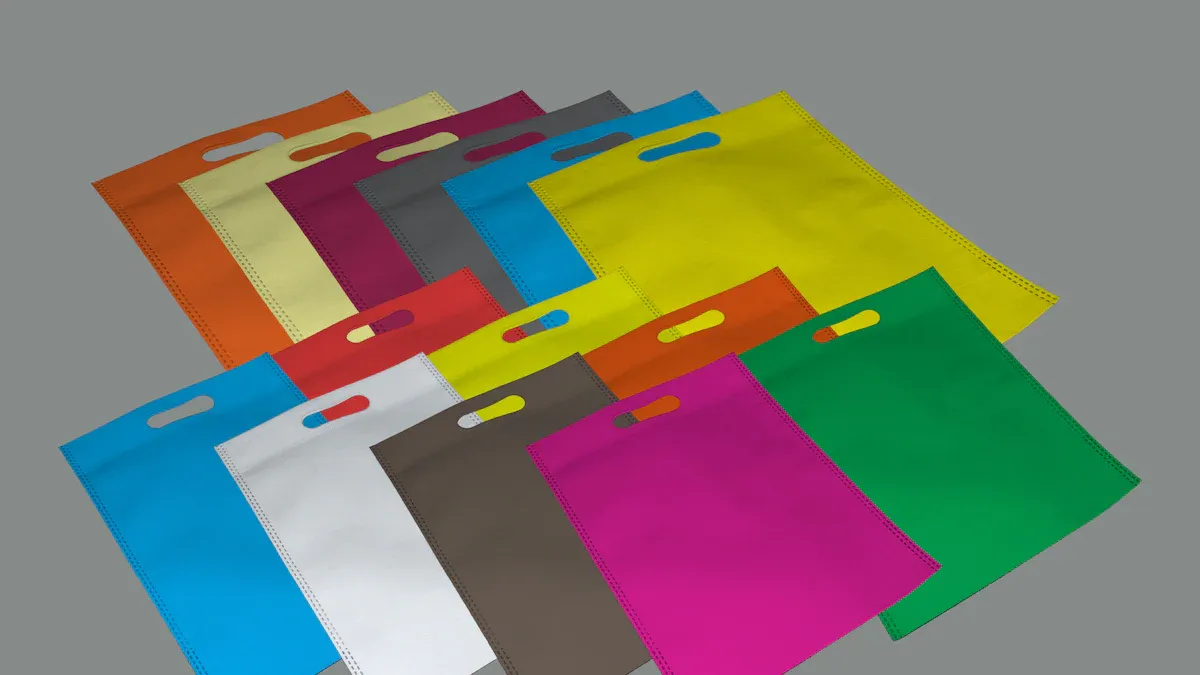
You use high molecular weight polymers to create continuous filament fibers. The spunbond method produces larger filaments, making it suitable for reusable items like shopping bags and agricultural sheets.
Meltblown Process:
You use high-velocity air to create extremely fine fibers in the micrometer range. This method excels at producing fabrics for filtration, such as surgical masks and N95 respirators.
| Method | Fiber Diameter | End-Use Applications |
|---|---|---|
| Meltblown | Micrometer range | Filtration (masks, air filters), barrier layers |
| Spunbond | Larger filaments | Reusable items (bags, covers), hygiene items |
The meltblown process creates finer fibers than spunbond, which improves filtration capabilities.
Other Bonding Methods (Spunlace, Needle-Punch, Airlaid)
You also find specialized bonding methods that give Nonwoven Fibers unique properties for specific uses.
| Bonding Method | Key Characteristics |
|---|---|
| Spunlace | High absorption, softness, excellent wet strength, ideal for skin contact and moisture management. |
| Needle-Punch | Superior abrasion resistance, structural stability, textured surface, high absorption, suitable for heavy-duty applications. |
| Airlaid | Used for products needing high absorbency and softness, such as hygiene items and industrial pads. |
Industry Applications:
| Industry | Application of Spunlace Nonwoven Fibers |
|---|---|
| Personal Care | Cleaning and hygiene products |
| Hygiene | Wipes and hygiene-related items |
| Industry | Application of Needle-Punch Nonwoven Fibers |
|---|---|
| Hygiene | Medical products, wipes, artificial leather |
| Medical | Medical drapes, food contact materials |
| Industry | Application of Airlaid Nonwoven Fibers |
|---|---|
| Hygiene | Baby wet wipes, feminine hygiene products |
| Industrial | Oil absorbent pads |
You choose spunlace for softness and absorbency, needle-punch for durability, and airlaid for high absorbency in hygiene and industrial products.
Properties and Uses of Nonwoven Fibers
Main Properties
You notice that Nonwoven Fibers display a range of physical and chemical properties that determine their performance in different applications.
- Density affects the weight and strength of the material.
- Absorption allows you to use these fibers in products that need to soak up liquids.
- Optical properties influence how the fabric looks and interacts with light.
- Dimension, including length, width, and caliper, impacts the fit and coverage.
- Frictional properties help control slip and grip.
- Swelling changes the shape when exposed to moisture.
- Electrical and thermal properties support uses in insulation and electronics.
Tip: You can select Nonwoven Fibers with specific properties to match the needs of your project, whether you want softness, strength, or absorbency.
Advantages
You benefit from several advantages when you choose Nonwoven Fibers over traditional textiles.
- You produce these materials at a lower cost because the process is faster and uses less labor.
- You tailor the fabric for absorbency, liquid repellency, or strength.
- The internal structure lets you control permeability and directionality.
- You find that lightweight nonwovens reduce transportation costs and improve storage efficiency.
- Manufacturers can use biodegradable materials, making these fibers a sustainable choice.
Common Applications
You see Nonwoven Fibers in many industries due to their versatility. The table below shows some common uses:
| Industry | Applications |
|---|---|
| Automotive | Foam car insulation, protective barriers, hook-and-loop fasteners, interior composites |
| Healthcare | Wound care products, surgical drapes, patient padding, comfort and cleanliness |
| Construction | Thermal insulation, soundproofing, moisture resistance, energy efficiency, sustainability |
You also find that 59.8% of production goes to disposable products, such as personal care items, medical supplies, and food packaging. The demand for these fibers in medical and hygiene sectors continues to rise, driven by the need for disposable and hygienic solutions.
You see nonwoven fibers created by bonding or interlocking natural or synthetic fibers.
- You select fibers for specific properties.
- You form a web using dry-laid, wet-laid, or spun-laid methods.
- You bond fibers mechanically, thermally, or chemically.
- You finish fabrics for softness or durability.
| Advantage | Impact on Industries |
|---|---|
| Versatility | Fits hygiene, medical, and automotive needs |
| Cost Efficiency | Reduces production costs for disposable and durable goods |
| Customization | Matches unique demands across sectors |
You notice rising demand in emerging markets, especially for sustainable and medical products. Nonwoven fibers continue to shape modern industries.
FAQ
What makes nonwoven fibers different from regular fabrics?
You see nonwoven fibers made by bonding or interlocking fibers, not weaving or knitting yarns. This process gives you faster production and unique properties.
Can you recycle nonwoven fibers?
You can recycle some nonwoven fibers, especially those made from single polymers. Check local recycling guidelines for specific products.
Where do you find nonwoven fibers in daily life?
You use nonwoven fibers in wipes, masks, filters, hygiene products, and insulation. These materials appear in many disposable and durable goods.